THE DYSAUTONOMIA MYTH: A 4-Part Series
- Natural Healing
- October 1, 2026
- No Comment
- 38 minutes read
By John J. Herbert, DC
Author of The Hidden Epidemic
Introduction
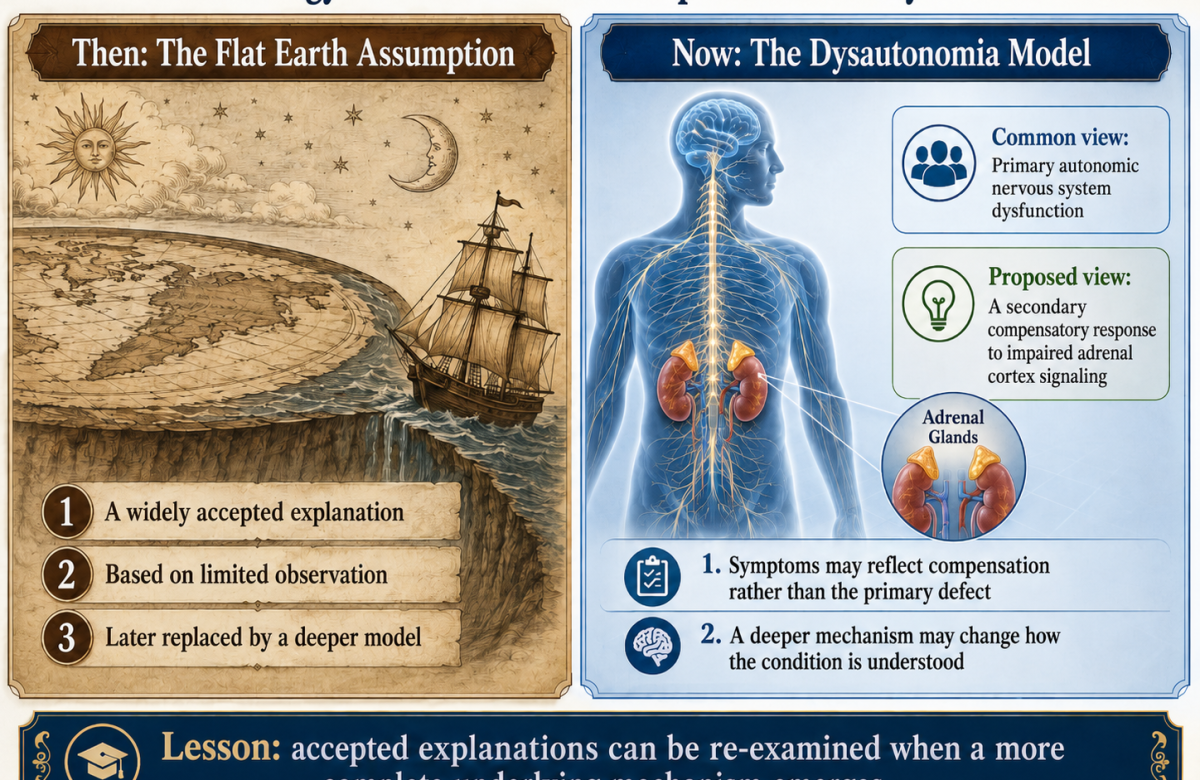
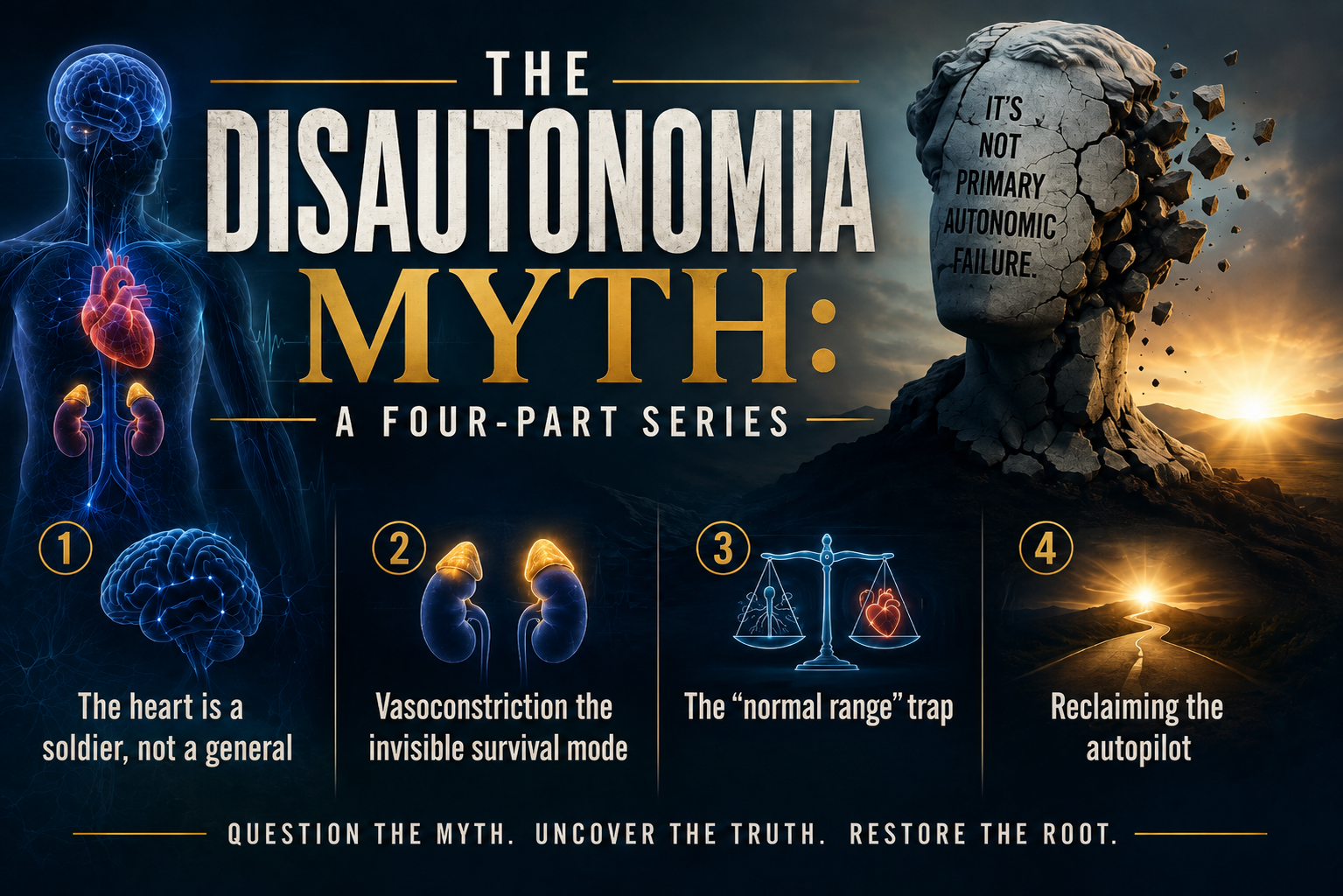
This series explores the breakdown of the feedback loop between the autonomic nervous system and the adrenal cortex—a signaling crisis that lies at the heart of POTS, ME/CFS, and other fatigue syndromes.
Part 1: The Heart is a Soldier, Not the General
If you have been diagnosed with POTS (Postural Orthostatic Tachycardia Syndrome), you have likely spent a significant amount of time staring at heart rate monitors. You’ve felt that terrifying thumping in your chest just from walking to the kitchen, and you’ve probably seen a cardiologist who performed an EKG, an Echo, and a Stress Test—only to tell you that your heart is “structurally normal.”
This creates a maddening paradox: If my heart is fine, why is it acting like I’m running a marathon while I’m just trying to brush my teeth?
The Military of the Body
To understand why this happens, we have to look at the chain of command in your body.
In a healthy system, your Autonomic Nervous System (ANS) acts like a military unit.
- The Heart is the Soldier: Its job is to pump blood where it’s told, when it’s told. It is strong, reliable, and obedient.
- The Adrenal Glands are the General: Their job is to issue the orders. They release the hormones (signals) that tell the Soldier exactly how fast to march and when to rest.
The “Orders” are the Problem
When you have POTS or Chronic Fatigue, the problem isn’t that the Soldier (the heart) is lazy or broken. The problem is that the General (the adrenals) has gone silent or is issuing “panic orders.”
In my research for The Hidden Epidemic, I’ve identified what I call the Signaling Gap. When your adrenal glands are in a state of subclinical insufficiency, they fail to provide the chemical “buffer” that keeps the nervous system calm.
Without that steady signal from the General, the nervous system panics. It senses that blood pressure might drop or that oxygen levels are unstable, and it begins screaming at the heart to “Run! Move! Pump faster!”
The heart, being a loyal soldier, does exactly what it’s told. It races. It pounds. It works overtime.
Treating the Wrong Victim
The tragedy of the modern medical approach is that we spend all our time trying to “discipline” the Soldier. We give patients beta-blockers to force the heart to slow down. While this can help with symptoms, it doesn’t fix the command structure. It’s like putting a gag on a soldier who is only shouting because the General told him there was an emergency.
The heart isn’t the problem; it’s the messenger.
A New Way Forward
If we want to stop the tachycardia, we have to stop the panic at the source. We have to restore the adrenal signal. When the General is back on the field, providing steady, consistent orders, the heart naturally slows down because it no longer needs to compensate for a signaling crisis.
In the next part of this series, we will look at Vasoconstriction—the “invisible” survival mode that keeps your body in a state of emergency even when you’re lying in bed.
Disclaimer: This article is provided for educational and informational purposes only and is not intended to diagnose, treat, cure, or prevent any medical condition. The concepts presented, including the proposed relationship between adrenal function, dysautonomia, POTS, ME/CFS, and related fatigue syndromes, reflect the author’s research, observations, and theoretical perspective and should not be considered established medical consensus. Readers should consult a qualified healthcare professional before making any changes to their medical care, medications, diet, supplements, or treatment plan.
Part 2: Vasoconstriction—The Invisible Survival Mode
Have you ever noticed that even on a warm day, your hands and feet feel like ice? Or perhaps you’ve experienced “brain fog” so thick it feels like your head is filled with cotton, even though you’ve had plenty of sleep?
In the world of dysautonomia and chronic fatigue, we often focus on the heart rate. But there is an invisible process happening beneath the surface that is just as responsible for your symptoms: Vasoconstriction.
The Body’s Emergency Valve
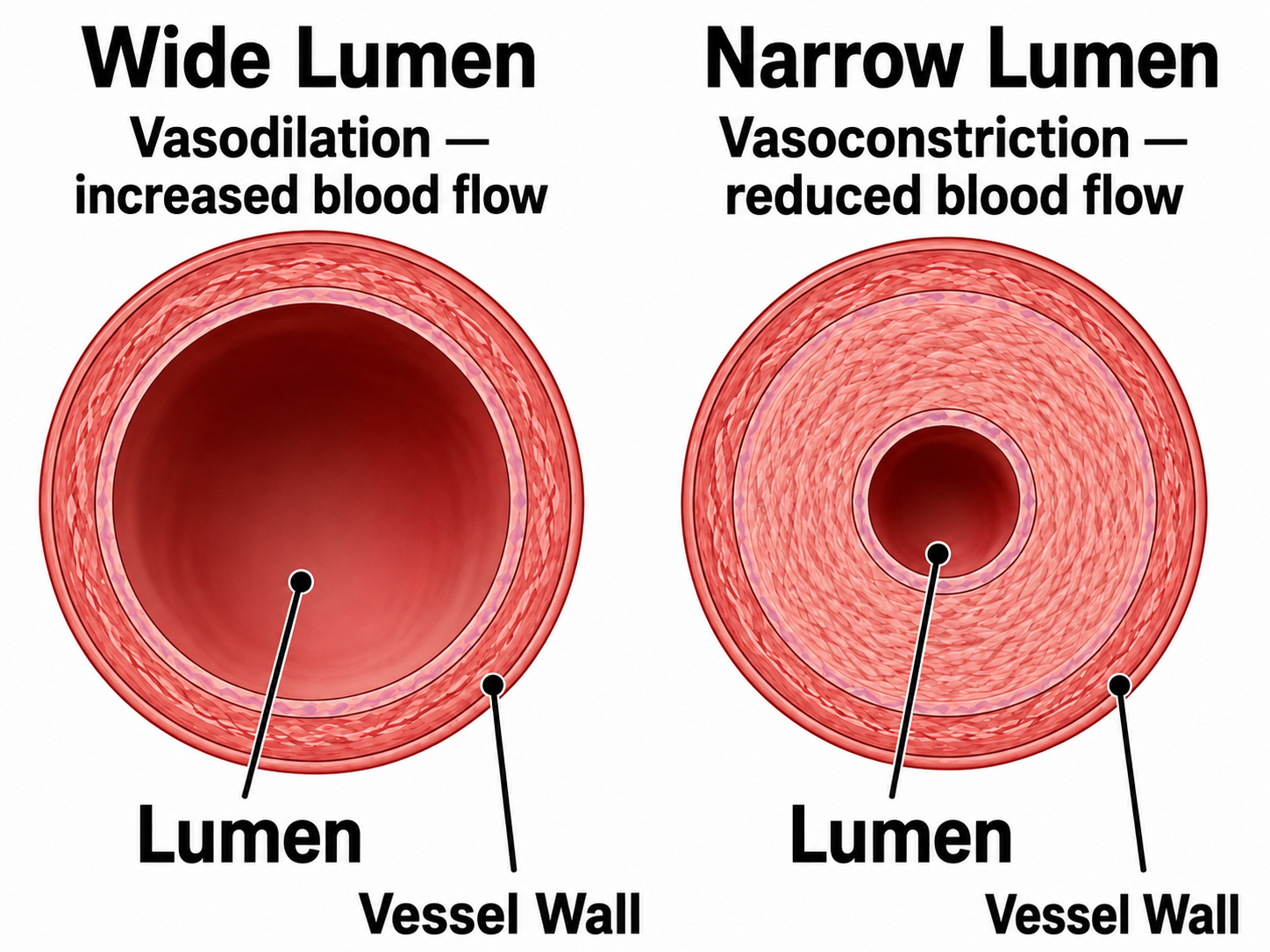
Vasoconstriction is the narrowing of your blood vessels. In a healthy “Fight or Flight” scenario, this is a brilliant survival tactic. If a tiger were chasing you, your sympathetic nervous system would instantly constrict the blood vessels in your skin, your digestive tract, and your kidneys.
Why? To shunt every available drop of blood toward your heart, lungs, and large muscles. Your body effectively “shuts down” the non-essential systems to ensure you have the power to run or fight.
Living in a Permanent Shunt
The problem for those with The Hidden Epidemic is that the “shunting” never stops. Because the adrenal “brake” isn’t functioning, your body remains in a state of permanent emergency. (See diagram 1.)
When your body stays in chronic vasoconstriction, you begin to experience a “starvation” of your peripheral systems:
- Cold Extremities: Your hands and feet are cold because the blood has been diverted to your core.
- Brain Fog: When blood vessels in the neck and head over-constrict, oxygen delivery to the brain becomes inconsistent.
- Digestive Distress: If the blood flow to your gut is constantly constricted, you can’t digest food properly, leading to bloating, pain, and “gastroparesis” symptoms.
The Adrenal Anchor
This is where the Signaling Gap becomes a physical reality. In a normal system, the adrenal glands release hormones that act as an “anchor.” These signals tell the blood vessels when it is safe to open back up (vasodilation) and allow the body to enter “Rest and Digest” mode.
Without that anchor, your blood vessels stay “clamped.” You are stuck in Survival Mode, burning through your metabolic resources while your vital organs operate on a skeleton crew of blood flow.
The “Wired but Tired” Paradox
This is exactly why you can feel “wired” (your blood vessels are constricted and your heart is racing) but “tired” (your organs and brain aren’t getting the nutrients and oxygen they need). You aren’t lazy; you are physiologically locked in a high-speed chase that never ends.
The goal of recovery isn’t just to lower the heart rate—it’s to reopen the pipes. By restoring the adrenal signal, we give the body permission to stop shunting and start nourishing.
Disclaimer: This article is provided for educational and informational purposes only and is not intended to diagnose, treat, cure, or prevent any medical condition. The concepts presented, including the proposed relationship between adrenal function, dysautonomia, POTS, ME/CFS, and related fatigue syndromes, reflect the author’s research, observations, and theoretical perspective and should not be considered established medical consensus. Readers should consult a qualified healthcare professional before making any changes to their medical care, medications, diet, supplements, or treatment plan.
Part 3: The “Normal Range” Trap
“Your labs are normal.”
For many of you, those four words are the most frustrating thing a doctor can say. You feel like you are vibrating with exhaustion, your heart is doing flip-flops, and your brain feels like it’s in a fog—yet the piece of paper in your doctor’s hand says you are perfectly healthy.
In The Hidden Epidemic, I argue that “normal” is often an arbitrary line in the sand that has very little to do with how your body actually functions.
The Problem with “Average”
Medical lab ranges are generally based on a “bell curve” of the population. To be labeled as having “Adrenal Failure” (Addison’s Disease), your hormone levels usually have to fall into the bottom 2.5% of the entire population.
But here is the catch: You don’t have to be in total failure to be in a signaling crisis.
Think of it like the oil in your car.
- The Medical View: They only care if the oil light is flashing and the engine is seizing up.
- The Reality: If your oil is dangerously low, your engine will run hot, it will wear down, and it will eventually stall—even if the “Low Oil” light hasn’t clicked on yet.
Subclinical is Not Sub-Important
When we talk about the Signaling Gap, we are talking about the “Subclinical” range. This is the gray area where your adrenals are producing some hormones, but not enough to meet the high demands of your overactive nervous system.
Because your results stay within that broad “normal” box, your doctor stops looking for a physiological cause and starts looking for a psychological one. This is why so many dysautonomia patients are misdiagnosed with anxiety or “somatic symptom disorder.”
Context is Everything
A cortisol level that is “normal” for a person sitting on a beach might be “dangerously low” for a person trying to navigate a high-stress job, a chronic infection, or a demanding family life.
The body doesn’t care about the lab’s average; it cares about the ratio of your Stress to your Support. If your stress is at a 10 and your adrenal support is at a 3, you are in a signaling deficit—even if that “3” is technically inside the normal range.
Breaking the Cycle
To recover, we have to stop treating the lab report and start treating the patient. We have to look at the trends of your symptoms:
- Does your fatigue follow a specific daily pattern?
- Do your symptoms flare after a specific type of stress?
- Does your body struggle to “reset” after a busy day?
These patterns tell a story that a single blood draw can’t. They point to a system that is struggling to stay afloat in the “Hidden Epidemic.”
Disclaimer: This article is provided for educational and informational purposes only and is not intended to diagnose, treat, cure, or prevent any medical condition. The concepts presented, including the proposed relationship between adrenal function, dysautonomia, POTS, ME/CFS, and related fatigue syndromes, reflect the author’s research, observations, and theoretical perspective and should not be considered established medical consensus. Readers should consult a qualified healthcare professional before making any changes to their medical care, medications, diet, supplements, or treatment plan.
Part 4: Reclaiming the Autopilot
In this series, we’ve unmasked the heart as a “tired soldier” and explored how “survival mode” keeps your body locked in a state of chronic vasoconstriction. We’ve also challenged the arbitrary lab ranges that leave so many patients without a map for recovery.
Now, the most important question remains: How do you fix a broken signal?
From Management to Restoration
The standard medical approach to dysautonomia is often about management. Doctors give you salt to increase blood volume, beta-blockers to slow the heart, or compression stockings to prevent pooling. While these tools may be helpful crutches, they don’t fix the underlying “Signaling Gap.”
To truly recover, we have to move toward restoration. We have to teach the General (the adrenals) how to lead again so the Soldier (the heart) can finally stand down.
The Protocol of Stability
In The Hidden Epidemic, I outline a framework for reclaiming your autonomic autopilot. It isn’t about a “magic pill”; it’s about a three-pronged approach to restoring the feedback loop:
- Closing the Signaling Gap: Using specific nutritional and lifestyle supports that provide the adrenal glands with the raw materials they need to produce a steady, reliable signal.
- Queting the Autonomic Fire: Implementing “bottom-up” techniques that tell the nervous system—physiologically—that the emergency is over.
- The Rhythmic Reset: Realigning your body’s daily cycles (circadian and ultradian) to match the natural pulse of adrenal output, rather than fighting against it.
The Goal: A “Quiet” Body
Think back to a time before you were sick. You didn’t “feel” your heart beating. You didn’t “feel” your blood vessels constricting. You didn’t have to think about your digestion. That is because a healthy autonomic nervous system is silent.
Restoration means returning to that silence. When the adrenal signal is restored, the “Wired but Tired” feeling begins to lift. The “Brain Fog” clears because blood flow is no longer being shunted away from your head. Your heart rate settles because it is finally receiving a signal of safety rather than a signal of panic.
Don’t Just Manage—Resolve
You were never meant to live in a state of permanent emergency. Your symptoms are not a sign that your body is failing you; they are a sign that your body is trying to save you with the limited signals it has left.
By understanding the adrenal-autonomic link, you can stop being a victim of your symptoms and start becoming the architect of your recovery.
Disclaimer: This article is provided for educational and informational purposes only and is not intended to diagnose, treat, cure, or prevent any medical condition. The concepts presented, including the proposed relationship between adrenal function, dysautonomia, POTS, ME/CFS, and related fatigue syndromes, reflect the author’s research, observations, and theoretical perspective and should not be considered established medical consensus. Readers should consult a qualified healthcare professional before making any changes to their medical care, medications, diet, supplements, or treatment plan.
Introduction
This series explores the breakdown of the feedback loop between the autonomic nervous system and the adrenal cortex—a signaling crisis that lies at the heart of POTS, ME/CFS, and other fatigue syndromes.
Part 1: The Heart is a Soldier, Not the General
If you have been diagnosed with POTS (Postural Orthostatic Tachycardia Syndrome), you have likely spent a significant amount of time staring at heart rate monitors. You’ve felt that terrifying thumping in your chest just from walking to the kitchen, and you’ve probably seen a cardiologist who performed an EKG, an Echo, and a Stress Test—only to tell you that your heart is “structurally normal.”
This creates a maddening paradox: If my heart is fine, why is it acting like I’m running a marathon while I’m just trying to brush my teeth?
The Military of the Body
To understand why this happens, we have to look at the chain of command in your body.
In a healthy system, your Autonomic Nervous System (ANS) acts like a military unit.
- The Heart is the Soldier: Its job is to pump blood where it’s told, when it’s told. It is strong, reliable, and obedient.
- The Adrenal Glands are the General: Their job is to issue the orders. They release the hormones (signals) that tell the Soldier exactly how fast to march and when to rest.
The “Orders” are the Problem
When you have POTS or Chronic Fatigue, the problem isn’t that the Soldier (the heart) is lazy or broken. The problem is that the General (the adrenals) has gone silent or is issuing “panic orders.”
In my research for The Hidden Epidemic, I’ve identified what I call the Signaling Gap. When your adrenal glands are in a state of subclinical insufficiency, they fail to provide the chemical “buffer” that keeps the nervous system calm.
Without that steady signal from the General, the nervous system panics. It senses that blood pressure might drop or that oxygen levels are unstable, and it begins screaming at the heart to “Run! Move! Pump faster!”
The heart, being a loyal soldier, does exactly what it’s told. It races. It pounds. It works overtime.
Treating the Wrong Victim
The tragedy of the modern medical approach is that we spend all our time trying to “discipline” the Soldier. We give patients beta-blockers to force the heart to slow down. While this can help with symptoms, it doesn’t fix the command structure. It’s like putting a gag on a soldier who is only shouting because the General told him there was an emergency.
The heart isn’t the problem; it’s the messenger.
A New Way Forward
If we want to stop the tachycardia, we have to stop the panic at the source. We have to restore the adrenal signal. When the General is back on the field, providing steady, consistent orders, the heart naturally slows down because it no longer needs to compensate for a signaling crisis.
In the next part of this series, we will look at Vasoconstriction—the “invisible” survival mode that keeps your body in a state of emergency even when you’re lying in bed.
Disclaimer: This article is provided for educational and informational purposes only and is not intended to diagnose, treat, cure, or prevent any medical condition. The concepts presented, including the proposed relationship between adrenal function, dysautonomia, POTS, ME/CFS, and related fatigue syndromes, reflect the author’s research, observations, and theoretical perspective and should not be considered established medical consensus. Readers should consult a qualified healthcare professional before making any changes to their medical care, medications, diet, supplements, or treatment plan.
PART 2: Vasoconstriction—The Invisible Survival Mode
Have you ever noticed that even on a warm day, your hands and feet feel like ice? Or perhaps you’ve experienced “brain fog” so thick it feels like your head is filled with cotton, even though you’ve had plenty of sleep?
In the world of dysautonomia and chronic fatigue, we often focus on the heart rate. But there is an invisible process happening beneath the surface that is just as responsible for your symptoms: Vasoconstriction.
The Body’s Emergency Valve
Vasoconstriction is the narrowing of your blood vessels. In a healthy “Fight or Flight” scenario, this is a brilliant survival tactic. If a tiger were chasing you, your sympathetic nervous system would instantly constrict the blood vessels in your skin, your digestive tract, and your kidneys.
Why? To shunt every available drop of blood toward your heart, lungs, and large muscles. Your body effectively “shuts down” the non-essential systems to ensure you have the power to run or fight.
Living in a Permanent Shunt
The problem for those with The Hidden Epidemic is that the “shunting” never stops. Because the adrenal “brake” isn’t functioning, your body remains in a state of permanent emergency. (See diagram 1.)
When your body stays in chronic vasoconstriction, you begin to experience a “starvation” of your peripheral systems:
- Cold Extremities: Your hands and feet are cold because the blood has been diverted to your core.
- Brain Fog: When blood vessels in the neck and head over-constrict, oxygen delivery to the brain becomes inconsistent.
- Digestive Distress: If the blood flow to your gut is constantly constricted, you can’t digest food properly, leading to bloating, pain, and “gastroparesis” symptoms.
The Adrenal Anchor
This is where the Signaling Gap becomes a physical reality. In a normal system, the adrenal glands release hormones that act as an “anchor.” These signals tell the blood vessels when it is safe to open back up (vasodilation) and allow the body to enter “Rest and Digest” mode.
Without that anchor, your blood vessels stay “clamped.” You are stuck in Survival Mode, burning through your metabolic resources while your vital organs operate on a skeleton crew of blood flow.
The “Wired but Tired” Paradox
This is exactly why you can feel “wired” (your blood vessels are constricted and your heart is racing) but “tired” (your organs and brain aren’t getting the nutrients and oxygen they need). You aren’t lazy; you are physiologically locked in a high-speed chase that never ends.
The goal of recovery isn’t just to lower the heart rate—it’s to reopen the pipes. By restoring the adrenal signal, we give the body permission to stop shunting and start nourishing.
Disclaimer: This article is provided for educational and informational purposes only and is not intended to diagnose, treat, cure, or prevent any medical condition. The concepts presented, including the proposed relationship between adrenal function, dysautonomia, POTS, ME/CFS, and related fatigue syndromes, reflect the author’s research, observations, and theoretical perspective and should not be considered established medical consensus. Readers should consult a qualified healthcare professional before making any changes to their medical care, medications, diet, supplements, or treatment plan.
Part 3: The “Normal Range” Trap
“Your labs are normal.”
For many of you, those four words are the most frustrating thing a doctor can say. You feel like you are vibrating with exhaustion, your heart is doing flip-flops, and your brain feels like it’s in a fog—yet the piece of paper in your doctor’s hand says you are perfectly healthy.
In The Hidden Epidemic, I argue that “normal” is often an arbitrary line in the sand that has very little to do with how your body actually functions.
The Problem with “Average”
Medical lab ranges are generally based on a “bell curve” of the population. To be labeled as having “Adrenal Failure” (Addison’s Disease), your hormone levels usually have to fall into the bottom 2.5% of the entire population.
But here is the catch: You don’t have to be in total failure to be in a signaling crisis.
Think of it like the oil in your car.
- The Medical View: They only care if the oil light is flashing and the engine is seizing up.
- The Reality: If your oil is dangerously low, your engine will run hot, it will wear down, and it will eventually stall—even if the “Low Oil” light hasn’t clicked on yet.
Subclinical is Not Sub-Important
When we talk about the Signaling Gap, we are talking about the “Subclinical” range. This is the gray area where your adrenals are producing some hormones, but not enough to meet the high demands of your overactive nervous system.
Because your results stay within that broad “normal” box, your doctor stops looking for a physiological cause and starts looking for a psychological one. This is why so many dysautonomia patients are misdiagnosed with anxiety or “somatic symptom disorder.”
Context is Everything
A cortisol level that is “normal” for a person sitting on a beach might be “dangerously low” for a person trying to navigate a high-stress job, a chronic infection, or a demanding family life.
The body doesn’t care about the lab’s average; it cares about the ratio of your Stress to your Support. If your stress is at a 10 and your adrenal support is at a 3, you are in a signaling deficit—even if that “3” is technically inside the normal range.
Breaking the Cycle
To recover, we have to stop treating the lab report and start treating the patient. We have to look at the trends of your symptoms:
- Does your fatigue follow a specific daily pattern?
- Do your symptoms flare after a specific type of stress?
- Does your body struggle to “reset” after a busy day?
These patterns tell a story that a single blood draw can’t. They point to a system that is struggling to stay afloat in the “Hidden Epidemic.”
Disclaimer: This article is provided for educational and informational purposes only and is not intended to diagnose, treat, cure, or prevent any medical condition. The concepts presented, including the proposed relationship between adrenal function, dysautonomia, POTS, ME/CFS, and related fatigue syndromes, reflect the author’s research, observations, and theoretical perspective and should not be considered established medical consensus. Readers should consult a qualified healthcare professional before making any changes to their medical care, medications, diet, supplements, or treatment plan.
Part 4: Reclaiming the Autopilot
In this series, we’ve unmasked the heart as a “tired soldier” and explored how “survival mode” keeps your body locked in a state of chronic vasoconstriction. We’ve also challenged the arbitrary lab ranges that leave so many patients without a map for recovery.
Now, the most important question remains: How do you fix a broken signal?
From Management to Restoration
The standard medical approach to dysautonomia is often about management. Doctors give you salt to increase blood volume, beta-blockers to slow the heart, or compression stockings to prevent pooling. While these tools may be helpful crutches, they don’t fix the underlying “Signaling Gap.”
To truly recover, we have to move toward restoration. We have to teach the General (the adrenals) how to lead again so the Soldier (the heart) can finally stand down.
The Protocol of Stability
In The Hidden Epidemic, I outline a framework for reclaiming your autonomic autopilot. It isn’t about a “magic pill”; it’s about a three-pronged approach to restoring the feedback loop:
- Closing the Signaling Gap: Using specific nutritional and lifestyle supports that provide the adrenal glands with the raw materials they need to produce a steady, reliable signal.
- Queting the Autonomic Fire: Implementing “bottom-up” techniques that tell the nervous system—physiologically—that the emergency is over.
- The Rhythmic Reset: Realigning your body’s daily cycles (circadian and ultradian) to match the natural pulse of adrenal output, rather than fighting against it.
The Goal: A “Quiet” Body
Think back to a time before you were sick. You didn’t “feel” your heart beating. You didn’t “feel” your blood vessels constricting. You didn’t have to think about your digestion. That is because a healthy autonomic nervous system is silent.
Restoration means returning to that silence. When the adrenal signal is restored, the “Wired but Tired” feeling begins to lift. The “Brain Fog” clears because blood flow is no longer being shunted away from your head. Your heart rate settles because it is finally receiving a signal of safety rather than a signal of panic.
Don’t Just Manage—Resolve
You were never meant to live in a state of permanent emergency. Your symptoms are not a sign that your body is failing you; they are a sign that your body is trying to save you with the limited signals it has left.
By understanding the adrenal-autonomic link, you can stop being a victim of your symptoms and start becoming the architect of your recovery.
Disclaimer: This article is provided for educational and informational purposes only and is not intended to diagnose, treat, cure, or prevent any medical condition. The concepts presented, including the proposed relationship between adrenal function, dysautonomia, POTS, ME/CFS, and related fatigue syndromes, reflect the author’s research, observations, and theoretical perspective and should not be considered established medical consensus. Readers should consult a qualified healthcare professional before making any changes to their medical care, medications, diet, supplements, or treatment plan.